
By William Shivers | CallCentersForHire.com
For more than 30 years, I have watched the call-center industry change.
I have watched technologies come and go. I have watched companies move from traditional phone systems to predictive dialers, from paper records to sophisticated CRMs, from local call centers to global operations, and from massive call-center floors to distributed workforces.
I have watched consumer expectations change.
I have watched regulation change.
And I have watched the industry repeatedly adapt to technology that people once believed would fundamentally eliminate the need for human agents.
Now we are facing perhaps the biggest transformation yet.
Artificial intelligence has entered the call center.
But I think we may be asking the wrong question.
For years, the question has been:
Will AI replace call center agents?
I believe the more important question is:
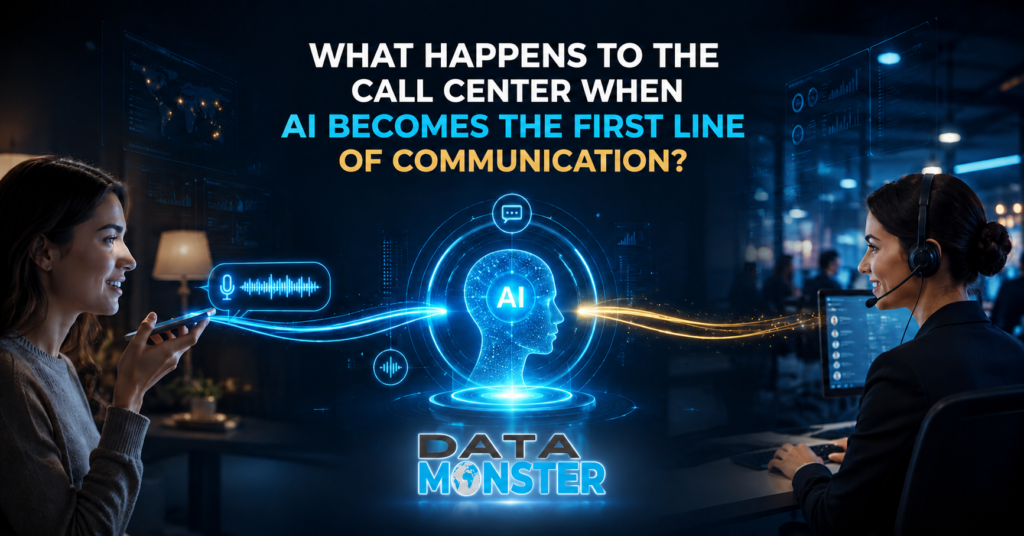
What happens to the call center when AI becomes the first line of communication?
That is a very different question.
And I believe the answer could be much more interesting than simply “AI takes the jobs.”
AI Will Absolutely Change Call Centers
Let’s start by being honest.
AI is going to replace some call-center work.
There is no reason to pretend otherwise.
Routine questions, repetitive transactions, appointment scheduling, basic account information, simple troubleshooting, call routing, summaries, data entry and other highly structured tasks are increasingly well suited to artificial intelligence.
Google itself describes AI Mode as capable of researching service costs, finding available appointment slots and checking inventory, and says that when information isn’t available online, Google can call businesses directly to obtain the answers.
That is not a prediction about the distant future.
It is already happening.
The question is what happens next.
The End of the Traditional Call Center?
I don’t think we’re necessarily watching the death of the call center.
I think we’re watching the death of a particular type of call center.
The traditional model was relatively simple:
A customer calls.
A phone rings.
A person answers.
The agent follows a script.
The agent records the interaction.
The next customer calls.
AI can dramatically compress that process.
But customer service itself has never been just about moving information from one place to another.
People call because they need something.
Sometimes that “something” is information.
Sometimes it is a solution.
Sometimes it is reassurance.
Sometimes it is patience.
Sometimes it is persuasion.
Sometimes it is a person who will actually listen.
Those are very different problems.
The Human Agent Isn’t Going Away. The Human Agent Is Changing.
This is where I believe much of the conversation surrounding AI is missing the bigger picture.
AI may reduce the number of people required to handle routine interactions.
That doesn’t automatically mean humans become irrelevant.
It may mean human workers become more valuable per interaction.
Imagine a customer contacts a company with a simple question about an appointment.
AI handles it.
Another customer needs an address changed.
AI handles it.
A third customer wants to know where an order is.
AI handles it.
Then a customer calls with a complicated billing dispute.
Another customer is furious because of a failed service.
Another is considering cancelling a major account.
Another has a problem nobody has encountered before.
Another simply wants to talk to someone.
That is where the human becomes increasingly important.
The future may not be:
AI versus human.
It may be:
AI first. Human when it matters.
The Work-From-Home Revolution May Become Even More Important
There is another major shift that cannot be ignored.
COVID dramatically accelerated the adoption of remote work.
The pandemic proved that enormous amounts of business activity could occur outside the traditional office.
Call centers were part of that transformation.
And now AI may accelerate it again.
Think about what happens when AI handles the routine workload while humans handle the exceptions.
Do you necessarily need thousands of agents sitting in one building?
Maybe not.
You may need highly capable people distributed across cities, states and countries.
You may need specialists who work flexible schedules.
You may need people who can step into a conversation when AI reaches its limits.
You may need remote customer-service professionals who specialize in sales, retention, escalation, technical support or high-value accounts.
The “call center” may increasingly become a workforce rather than a building.
Could the Office Building Become Obsolete?
This sounds like science fiction, but consider where the technology is heading.
Imagine walking into a corporate office a few years from now.
There may be no receptionist.
An AI system handles the front desk.
Visitors are checked in digitally.
Routine customer inquiries are handled automatically.
The physical phone system is largely AI-managed.
Remote employees handle specialized customer interactions from wherever they happen to live.
Automated systems monitor the building.
Robotics eventually handles portions of cleaning, maintenance and security.
The office may still exist, but it could become something very different from the office of the 1990s or 2000s.
That doesn’t necessarily mean fewer people working.
It may mean fewer people required to be physically present.
Then There Is Compliance
This is an area where I believe experience matters.
I have spent more than three decades watching the call-center industry adapt to regulatory and compliance changes.
The industry has had to navigate TCPA requirements, do-not-call rules, consent requirements, state regulations, consumer-protection concerns, privacy requirements, call-recording issues and an ever-growing collection of rules that businesses must understand before they pick up the phone.
AI introduces another layer.
Who is responsible when an AI system makes a mistake?
Who is responsible when it says something it shouldn’t?
Who is responsible when the system misunderstands consent?
Who is responsible when a customer asks for something outside the system’s authority?
The industry will have to answer those questions.
And I suspect that compliance will become an increasingly important reason to keep humans in the loop.
The Rise of the Human-AI Hybrid
I believe this is where we are headed.
AI can become the first line of communication.
It can greet customers.
Understand intent.
Collect information.
Authenticate customers.
Answer routine questions.
Route interactions.
Summarize conversations.
Recommend solutions.
And assist human agents in real time.
The human then takes over when judgment, empathy, negotiation, creativity or accountability are required.
That creates a hybrid environment where each side does what it does best.
AI provides speed, consistency and scale.
Humans provide judgment, personality, empathy and relationship.
And that combination may be far more powerful than either one operating alone.
Don’t Underestimate Personality
There is something else I don’t want the industry to overlook.
People still like dealing with people.
A work-from-home mother answering calls from her home office may be sitting hundreds of miles away from the company’s headquarters, but she may still be better at making a customer feel comfortable than the most technically sophisticated AI on the market.
She can laugh.
She can recognize frustration.
She can hear something in a customer’s voice.
She can improvise.
She can say, “I understand why you’re upset.”
She can say, “I’ve seen this before. Let me help you.”
And that human connection matters.
The future of customer service isn’t necessarily about making humans disappear.
It may be about giving humans better tools.
AI May Actually Create More Valuable Call-Center Jobs
This is where I disagree with the simplistic prediction that AI automatically means the end of the call-center workforce.
AI can eliminate jobs.
But it can also change the definition of the job.
The agent who once spent an entire shift answering repetitive questions may eventually spend that same shift solving difficult problems.
The person who once spent hours documenting calls may have AI handle the documentation.
The person who used to search five systems for an answer may have AI assemble the information instantly.
Instead of asking:
“How many calls can this employee handle?”
companies may begin asking:
“How much value can this employee create during the calls that truly require a human?”
That is a completely different measurement.
Call Center 3.0
I believe we are entering what I would call Call Center 3.0.
Call Center 1.0 was the traditional physical operation.
People sat in buildings.
Phones rang.
Scripts were followed.
Call Center 2.0 introduced cloud technology, globalization, outsourcing, advanced routing and remote workers.
Now we are moving into Call Center 3.0.
AI becomes part of the infrastructure.
Humans become specialized.
Work becomes increasingly distributed.
Customer interactions become more intelligent.
Routine work becomes automated.
And the human workforce focuses increasingly on the interactions where human judgment actually creates value.
That is not the death of the call center.
It is a transformation of the call center.
I Don’t Think the Industry Is Shrinking. I Think It Is Evolving.
There will certainly be fewer people doing some types of call-center work.
There will be companies that over-automate.
There will be customers who become frustrated with AI.
There will be businesses that discover that cutting human interaction was a mistake.
There will also be entirely new jobs and specialties that we haven’t even named yet.
AI conversation supervisors.
AI quality-control specialists.
Escalation specialists.
Human retention agents.
AI compliance specialists.
Remote relationship managers.
Human closers working alongside AI.
And countless other roles.
That is why I believe the future is much more complicated—and much more promising—than the headline “AI is replacing call centers.”
The Call Center Revolution
For more than 30 years, I have watched this industry adapt to technology that changed the way people communicate.
I don’t believe AI is going to end that evolution.
I believe AI is going to accelerate it.
The question isn’t whether some jobs disappear.
They will.
The question isn’t whether automation changes the economics of the industry.
It will.
The real question is what we build on the other side of that change.
At CallCentersForHire, we believe the answer is not a call-center closure.
It is a call-center revolution.
AI will handle what AI does best.
Humans will handle what humans do best.
And the companies that understand how to combine the two may discover something unexpected:
The future of the call center may be bigger than its past.
AI may not be replacing the call center.
AI may be helping us build the next one.
— William Shivers
Call Center Industry Veteran | 30+ Years of Experience
CallCentersForHire.com