Sales Has Taught Me Something Technology Hasn’t Changed
By William Shivers | CallCentersForHire.com
I’ve spent virtually my entire adult—and even part of my pre-adult—life around sales, leads and call centers.
Over more than three decades, I’ve watched technologies arrive that were supposedly going to change everything. I’ve watched regulations reshape entire campaigns. I’ve watched industries boom, collapse and reinvent themselves.
During my years in the vacation and timeshare lead industry alone, my companies worked with hundreds of call centers. I knew many of the major players. I worked with operations throughout the United States and with companies and centers in India, the Philippines, Central America, South America and beyond.
I’ve seen enormous call centers.
I’ve seen ten-person rooms.
I’ve seen startups become major operations.
I’ve seen major operations disappear.
I’ve watched short-lived campaigns become the hottest thing in the industry and vanish almost as quickly.
I’ve watched long-term campaigns survive technological changes that people once predicted would destroy them.
If there is one lesson I’ve learned from all of it, it is this:
Call centers don’t stand still.
And right now, I believe we are entering one of the biggest transformations this industry has ever experienced.
I call it:
Call Center 3.0
But to understand where we’re going, we have to understand what just happened.
The First Assault Wasn’t AI
When people talk about the future of call centers today, almost every conversation begins with artificial intelligence.
Mine doesn’t.
The first major assault on the traditional call-center model came before the current AI revolution.
It came in 2020.
COVID changed the workplace almost overnight.
Companies that had spent decades believing employees needed to occupy a physical building suddenly discovered that enormous numbers of them could work from home.
That raised an uncomfortable question for our industry:
If an agent can do the job from a spare bedroom, why does the company need a building filled with 750 agents?
And the same question applied at the other end of the market.
What happens to the ten-person room?
The small operation?
The independent call-center owner paying rent, utilities, telecommunications expenses, management, equipment and all the overhead required to keep the lights on?
The economics changed.
And they changed fast.
Some operations adapted.
Some struggled.
Some disappeared.
Across the industry, confusion was everywhere.
I Changed CallCentersForHire Too
I didn’t exactly close Data Monster or CallCentersForHire when the pandemic hit.
Instead, I fundamentally changed what the marketplace did.
I converted it into what was essentially a BY OWNER marketplace.
I removed agent involvement.
Seller contact information was exposed directly to buyers.
Buyers and sellers could communicate and transact with one another without us sitting in the middle.
I removed the protected transaction model we had previously used and allowed direct buyer-to-seller relationships.
And then I watched.
I kept the website online partly as a gift to the buyers, sellers and call-center professionals I had worked with for more than a decade.
But I was also watching an industry I knew intimately go through something unprecedented.
I wanted to understand what it was becoming.
I knew remote work wasn’t simply a temporary response to a pandemic.
It was the beginning of a workforce revolution.
What I didn’t know yet was how quickly the next revolution would arrive.
Then Came AI
When artificial intelligence began moving aggressively into customer service, I knew it was time for me to pay very close attention again.
Because suddenly the conversations changed.
Call-center operators weren’t merely asking how to manage remote workers.
They were asking something much more frightening:
Are we still going to be needed?
I’ve heard the concern directly.
And in some cases, unfortunately, the fear isn’t imaginary.
Call centers have closed.
Customer-service operations have automated functions previously performed by people.
AI is increasingly capable of answering routine questions, retrieving information, scheduling appointments, routing customers, documenting conversations, summarizing calls and handling interactions that once required a human being.
Pretending otherwise isn’t helping anyone.
But neither is panicking.
I’ve watched enough revolutions in this industry to know that when the wave is coming, screaming at the ocean isn’t much of a strategy.
You adapt and ride the wave.
Some Call-Center Jobs Are Going Away
I think we need to say this plainly.
If a person’s primary value to an organization is:
Answer the phone.
Read the script.
Look up information.
Enter information.
Follow a predictable decision tree.
Document what happened.
Move to the next call.
Then AI presents a serious challenge to that position.
Machines are extraordinarily good at repetitive, structured processes.
They can retrieve information instantly.
They don’t forget which screen contains the answer.
They can summarize conversations automatically.
They can populate systems.
They can process enormous amounts of data.
They can operate continuously.
That part of the call-center industry is going to change.
But that isn’t the entire call-center industry.
And it certainly isn’t the entire human conversation.
Stop Hiring for Yesterday’s Call Center
For decades, many entry-level call-center hiring decisions included questions like:
Can you type?
Can you follow a script?
Can you use the computer?
Can you show up on time?
Can you handle the call volume?
Those things still matter.
But I believe Call Center 3.0 requires us to start asking different questions.
Can this person listen?
Can this person build trust?
Can they recognize hesitation?
Can they communicate confidence?
Can they tell a story?
Can they make someone feel understood?
Can they solve a problem that isn’t covered by the script?
Can they sell?
Those abilities are about to become much more valuable.
Sales Has Taught Me Something Technology Hasn’t Changed
Products change.
Campaigns change.
Technology changes.
But one element of sales has remained remarkably consistent throughout my career:
People buy from people they trust.
A highly trained salesperson hears things that aren’t necessarily contained in the words being spoken.
There can be the tiniest hesitation in a customer’s voice.
A little fear.
Excitement.
Doubt.
Desire.
The customer may say:
“That sounds pretty good.”
An inexperienced agent hears interest.
An exceptional salesperson may hear:
I want this, but I’m afraid I’m making the wrong decision.
That salesperson knows not only what to say next, but sometimes when not to say anything.
They know when to tell a story.
They know when to reassure.
They know when to explain.
They know when to stop selling and start listening.
They draw on their own life experience.
They relate.
That is the human element.
The More AI We Use, the More Valuable Humanity May Become
This is the paradox I think many people are missing.
AI could make certain human qualities more valuable, not less.
If AI handles the easy interactions, why is the customer being transferred to a human?
Because something about that interaction requires a human.
Therefore, being human becomes part of the job description.
Personality matters.
Empathy matters.
Humor matters.
Patience matters.
Storytelling matters.
Judgment matters.
Emotional intelligence matters.
Life experience matters.
The qualities we historically called “soft skills” may become some of the hardest skills to replace.
The more artificial intelligence enters customer service, the more valuable authentic humanity may become.
Call Center 3.0 Isn’t Human Versus AI
This is where I believe the conversation needs to change.
Everyone wants to stage a competition:
Human versus AI.
Who wins?
Who gets the job?
Who gets replaced?
I think that’s the wrong contest.
Put them on the same team.
AI is capable of giving a human salesperson something no salesperson in history has ever possessed:
machine-scale intelligence in real time.
Imagine an exceptional salesperson from twenty or thirty years ago.
Great personality.
Incredible listener.
Natural storyteller.
Understands people instinctively.
Knows when to push.
Knows when to back off.
Now give that salesperson instant access to:
customer history,
previous conversations,
product information,
account information,
real-time transcription,
sentiment indicators,
potential objections,
compliance reminders,
competitive information,
suggested next actions,
automated documentation,
and AI-generated follow-up.
What have we done?
We haven’t replaced the salesperson.
We’ve given the salesperson superpowers.
Meet the Apex-Agent
That is the person I believe begins to emerge in Call Center 3.0.
I call this new generation of AI-enhanced human professional the Apex-Agent.
An Apex-Agent isn’t artificial intelligence.
The Apex-Agent is human.
AI is the amplification layer surrounding that human.
Before the call, AI can prepare them.
During the conversation, AI can provide real-time intelligence—the proverbial whisper in the agent’s ear.
After the conversation, AI can handle much of the administrative work that once consumed the agent’s time.
But during the most important moment—the actual human interaction—the agent brings something else:
Experience.
Instinct.
Empathy.
Personality.
Judgment.
Persuasion.
Storytelling.
Human consciousness.
The technology knows an extraordinary amount about the interaction.
But the human understands what it feels like to be human.
The machine knows. The human understands.
That is the Apex-Agent.
And we’ll be talking much more about them.
AI Shouldn’t Make the Agent Less Human
This may be one of the greatest opportunities artificial intelligence gives the call-center industry.
Think about how much of an agent’s attention historically went toward operating the machinery around the conversation.
Find the customer.
Open the account.
Search the CRM.
Find the product.
Look for the answer.
Write the notes.
Choose the disposition.
Schedule the follow-up.
Document everything.
What if AI increasingly handles that?
Then the salesperson can concentrate on what we wanted that salesperson doing all along:
Talking to another human being.
AI shouldn’t make the salesperson less human.
It should free the salesperson to become more human.
The Call Center Becomes a Workforce, Not Necessarily a Building
COVID already showed us this direction.
Call Center 3.0 accelerates it.
The best salesperson for a company may be in Florida.
Or Manila.
Or Bogotá.
Or Mumbai.
Or sitting at a kitchen table in a town most of us have never heard of.
What matters increasingly isn’t where the desk is located.
What matters is talent.
Connectivity.
Availability.
Specialization.
Performance.
And the ability to use technology effectively.
That could mean fewer massive physical call-center floors while simultaneously creating an enormous distributed customer-communication workforce.
That’s why I don’t believe measuring the future of this industry by the number of traditional call-center buildings makes sense anymore.
The building can shrink while the workforce expands.
Our Measurements May Need to Change Too
If AI handles the simple interactions, the human agents will increasingly inherit the difficult ones.
That creates another problem.
Traditional call centers have spent decades measuring things like average handle time.
But imagine an Apex-Agent spending 45 minutes with an angry customer and saving a relationship worth tens of thousands of dollars.
Did that agent perform poorly because the call took too long?
Of course not.
Call Center 3.0 may require a different philosophy.
Customer confidence.
First-contact resolution.
Retention.
Revenue.
Relationship value.
Sentiment improvement.
Successful escalation.
Lifetime customer value.
We may need to stop asking how quickly the human got off the phone and start asking:
What happened because the human stayed on it?
The Best Human Agents May Become More Valuable
There is another prediction I’m willing to make.
As repetitive work becomes automated, exceptional human communicators may rise dramatically in value.
The extraordinary salesperson.
The retention specialist who can save almost any account.
The empathetic service representative who can calm an enraged customer.
The negotiator.
The storyteller.
The closer.
The person customers somehow trust thirty seconds after meeting them.
If the reason we’re escalating an interaction to a human is because the interaction specifically needs humanity, then those people become extremely important.
Call Center 3.0 may be less forgiving of mediocre human communication.
But it may be extraordinarily rewarding for great human communication.
AI Will Also Study Us
There is another side to this revolution that fascinates me.
Call centers generate an extraordinary amount of information about human communication.
Millions of questions.
Objections.
Complaints.
Hesitations.
Buying signals.
Negotiations.
Emotional reactions.
Successful sales.
Failed sales.
Moments where trust was created.
Moments where trust was destroyed.
AI can analyze those interactions at a scale no human management team ever could.
That means humans will use AI to become better communicators.
But AI will also study successful humans to become better at understanding us.
A feedback loop develops:
Human experience → AI learning → human assistance → better interaction → more learning.
In that sense, Call Center 3.0 could become one of the world’s great laboratories for understanding human communication.
And that brings responsibility with it.
There Must Be a Line Between Understanding and Manipulation
If AI becomes capable of recognizing emotional vulnerability, fear, urgency, financial stress or other deeply human characteristics, businesses need ethical boundaries around how that intelligence is used.
Understanding a customer so you can communicate effectively is one thing.
Exploiting vulnerability is another.
Call Center 3.0 cannot simply be about building the most powerful persuasion machine ever created.
It must also involve compliance, transparency, judgment and accountability.
Technology becomes more powerful.
Our responsibility has to grow with it.
So, Should Call Centers Be Afraid?
I understand why people are.
I’ve watched operations close.
I’ve spoken with people who genuinely don’t know where the industry is headed.
I’ve watched one major workforce revolution already tear through the traditional call-center model.
And now another one is arriving before the dust has fully settled.
My advice is not:
“Don’t worry. Nothing is going to change.”
Everything is going to change.
My advice is:
Don’t panic. Adapt.
If your call center was built around humans doing what machines can now do better, you have a problem.
If your call center is built around humans doing what humans do best, you may have an extraordinary opportunity.
Move toward sales.
Move toward retention.
Move toward complex customer interactions.
Hire personality.
Hire empathy.
Hire listeners.
Hire storytellers.
Hire people who understand people.
And then give those people the most powerful AI tools you can responsibly put in their hands.
Welcome to Call Center 3.0
Call Center 1.0 put people in buildings and connected them to telephones.
Call Center 2.0 brought cloud technology, globalization, outsourcing, sophisticated routing and eventually the remote-work revolution.
Call Center 3.0 combines something far more powerful:
Artificial intelligence + distributed human talent + real-time data + human empathy, intuition and experience.
Some jobs will disappear.
Some call centers will disappear.
Some business models will disappear.
I’ve seen that happen before.
But something new will take their place.
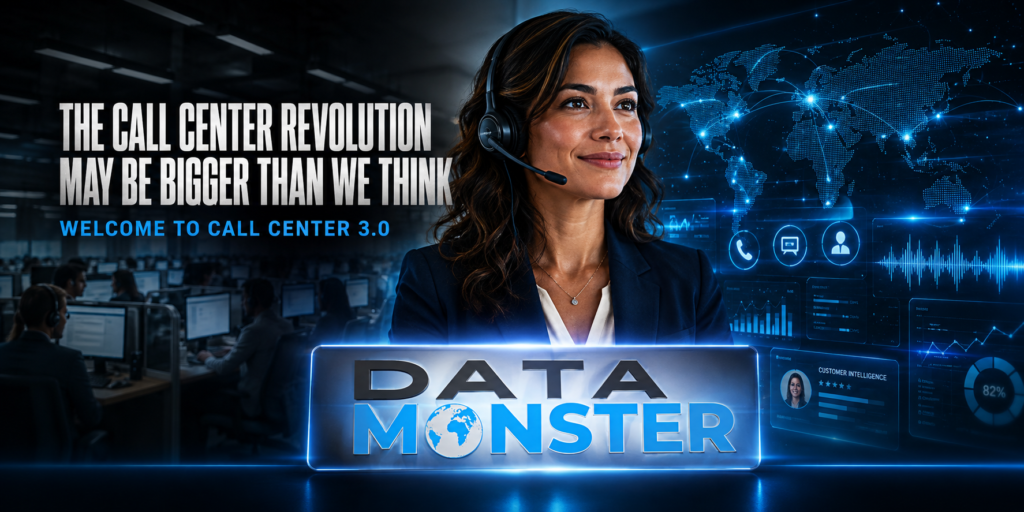
And I believe the call-center revolution may be much bigger than we think.
The future isn’t AI.
The future isn’t human.
The future is what happens when we finally stop making them compete and start making them work together.
So to the call-center owners wondering whether it’s over:
No.
But the old playbook is.
To the agents wondering whether they still have a place:
Absolutely.
But develop the qualities that make someone want to speak to a human in the first place.
And to an industry I’ve watched reinvent itself throughout my life:
We’ve ridden waves before.
Here comes another one.
Adapt.
Ride it.
And welcome to Call Center 3.0.
— William Shivers
Call Center Industry Veteran | 30+ Years of Experience
CallCentersForHire.com