What Is an Apex-Agent?
By William Shivers | CallCentersForHire.com
For years, we’ve been asking the same question:
Will artificial intelligence replace the salesperson?
I think we’re asking the wrong question.
What happens if we stop putting the salesperson and artificial intelligence on opposite sides of the ring?
What happens if we put them on the same team?
Take an exceptional salesperson—the kind of person who can hear hesitation in someone’s voice before the customer even admits they have an objection.
Give that salesperson artificial intelligence.
Give them instant customer intelligence.
Give them perfect recall.
Give them predictive insights.
Give them real-time information.
Give them automated research.
Give them an intelligent whisper in their ear while they’re actually speaking with the customer.
Then eliminate much of the administrative work waiting for them when the conversation ends.
What do you have?
You don’t have a salesperson competing against artificial intelligence.
You have a salesperson with superpowers.
Welcome to Call Center 3.0.
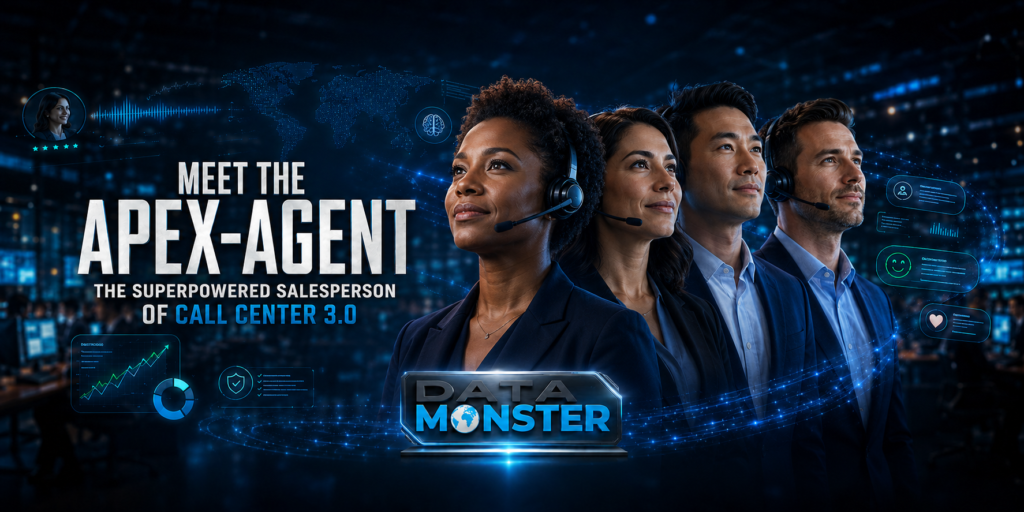
Meet the Apex-Agent.
What Is an Apex-Agent?
An Apex-Agent is a next-generation human sales professional whose natural abilities in communication, empathy, intuition, storytelling and persuasion are amplified by artificial intelligence, predictive data and real-time intelligence before, during and after every customer interaction.
There is an important distinction in that definition.
The AI is not the Apex-Agent.
The human is.
Artificial intelligence is the amplification layer.
I believe that’s an important way for the call-center industry to begin thinking about AI.
We have spent too much time asking which human functions machines can replace.
Let’s start asking a different question:
What could our best people accomplish if machines amplified everything they already do well?
Think About the Best Salesperson You’ve Ever Known
I’ve spent more than 30 years around sales and call centers.
During that time, I’ve encountered extraordinary salespeople.
The best ones aren’t simply good at memorizing scripts.
In fact, many of the truly great salespeople I’ve known could take a script and make you forget there ever was one.
They listen.
They relate.
They tell stories.
They recognize patterns.
They know when a customer is interested.
They recognize fear.
They hear uncertainty.
They can distinguish between a genuine objection and an excuse.
And sometimes they hear something most people would completely miss.
A customer says:
“Yeah… that sounds pretty good.”
The words appear positive.
But the salesperson hears the pause.
The slight change in tone.
The uncertainty.
And immediately understands:
This person wants what I’m selling, but something is making them uncomfortable.
That’s where selling actually happens.
Not in the database.
Not in the script.
Not in the CRM.
Between two people.
Now Give That Salesperson AI
This is where things get exciting.
Imagine that same salesperson entering a conversation already armed with information that previously would have taken hours—or might never have been available at all.
Depending on the business and the information legitimately available to it, AI could help assemble:
Customer history.
Previous interactions.
Previous purchases.
Products viewed.
Questions previously asked.
Lead source.
Account information.
Relevant product information.
Past objections.
Open service issues.
Previous sales notes.
Competitive information.
Relevant offers.
And other information important to that particular interaction.
Before the conversation even begins, the Apex-Agent can potentially understand far more context than yesterday’s salesperson ever could.
But that’s only the beginning.
Then Comes the Whisper
This may become one of the most powerful tools in Call Center 3.0.
While the human is having the conversation, AI can work quietly alongside them.
I think of it as The Whisper.
Not another screen demanding attention.
Not a replacement voice talking over the agent.
An intelligence layer operating in real time.
The customer asks a complicated product question.
The answer appears.
The customer mentions a competitor.
Relevant competitive information surfaces.
A compliance issue appears.
The agent gets a reminder.
A previous conversation becomes relevant.
The information is available immediately.
An objection appears.
Relevant information can be surfaced.
The customer asks something the salesperson has never encountered before.
Instead of putting the person on hold and searching through multiple systems, the information can potentially come directly to the agent.
The salesperson keeps doing what the salesperson does best:
having the conversation.
The Machine Knows. The Human Understands.
This is the distinction at the heart of the Apex-Agent.
Artificial intelligence can process extraordinary amounts of information.
It can identify patterns.
Retrieve facts.
Analyze language.
Summarize conversations.
Search enormous knowledge bases.
Recognize correlations.
And increasingly, AI systems can analyze aspects of sentiment and conversational behavior.
We shouldn’t underestimate those capabilities.
But information and human understanding are not necessarily the same thing.
AI might recognize that a customer repeatedly mentioned price.
The salesperson may realize:
This isn’t really about price. They’re afraid of making the wrong decision.
AI may identify hesitation.
The human understands what hesitation feels like.
AI may surface an objection.
The salesperson remembers having the exact same fear when making a major purchase five years ago.
And suddenly the salesperson has a story.
A real one.
Something relatable.
Something human.
That’s why I describe the relationship this way:
The machine knows. The human understands.
Storytelling Still Sells
This is something I’ve watched throughout my entire career.
Products change.
Industries change.
Technology changes.
But human beings still respond to stories.
A feature tells someone what something does.
A story helps someone understand why it matters to them.
The great salesperson doesn’t simply say:
“This product has Feature X.”
They say:
“Let me tell you about another customer who was worried about exactly the same thing you are…”
Suddenly the product isn’t abstract anymore.
The customer can see themselves in the story.
That ability draws on empathy, timing, communication and life experience.
Maybe AI eventually becomes indistinguishable from humans in every aspect of that process.
I won’t pretend to know what technology looks like 100 years from now.
But we’re not selling products 100 years from now.
We’re selling them today.
And today, relatable human communication remains enormously powerful.
AI Shouldn’t Make Salespeople Less Human
This is where I think companies can get Call Center 3.0 completely wrong.
If you give a salesperson AI and turn them into someone staring at fifteen flashing recommendations while mechanically repeating machine-generated sentences, you haven’t created an Apex-Agent.
You’ve created a human interface for software.
That’s not the objective.
The objective is almost the opposite.
AI should remove distractions from the salesperson.
Find the information.
Retrieve the record.
Summarize the history.
Document the call.
Schedule the follow-up.
Surface the relevant knowledge.
Handle the repetitive administrative tasks.
And then let the salesperson concentrate on something revolutionary:
The customer.
AI shouldn’t make salespeople less human.
It should give them more time to be human.
Personality Is About to Become a Premium Skill
For years, many call centers hired primarily around operational requirements.
Can the person type?
Can they follow instructions?
Can they read the script?
Can they navigate the software?
Can they handle the volume?
Those requirements aren’t disappearing completely.
But AI can increasingly assist with many of them.
So what separates one human agent from another?
Personality.
Empathy.
Listening.
Curiosity.
Confidence.
Humor when appropriate.
Patience.
Judgment.
Storytelling.
Persuasion.
Emotional intelligence.
The ability to make another person feel comfortable.
Those so-called “soft skills” may become some of the hardest skills in the entire operation.
Because if the company has deliberately transferred an interaction from AI to a human, there should be a reason.
The customer is getting a human because being human adds value to that conversation.
That changes who we should hire.
Stop Hiring Typists. Start Hiring Communicators.
If I were advising a sales-focused call center preparing for Call Center 3.0, I wouldn’t be asking only how many AI systems they plan to purchase.
I’d be looking at the people.
The industry needs to rethink what makes a great agent.
Find people who naturally communicate.
Find people who listen.
Find the person who somehow makes strangers comfortable.
Find the storyteller.
Find the person who understands when someone needs reassurance.
Find people with personality.
Find people with genuine empathy.
Find people with life experience.
Find people who can think when the script no longer applies.
And then teach those people how to use AI.
Because teaching a naturally gifted communicator how to operate technology may prove much easier than teaching technology how to genuinely become that person.
The Apex-Agent Before the Call
Call Center 3.0 begins before “hello.”
Yesterday’s salesperson often entered a conversation knowing little more than a name, phone number, lead source and perhaps a few notes.
The Apex-Agent can potentially enter armed with context.
AI can organize what is known.
Identify relevant history.
Prepare information.
Surface likely needs.
Highlight unresolved issues.
Make relevant product knowledge immediately accessible.
The objective isn’t to overwhelm the salesperson with data.
It’s to ensure that the human doesn’t have to start every conversation blind.
Preparation becomes automated intelligence.
The Apex-Agent During the Call
This is where the human takes center stage.
AI listens and assists.
The human communicates.
The machine can surface knowledge.
The human decides whether it matters.
The machine can detect a pattern.
The human decides how to respond.
The machine can suggest.
The human judges.
The customer isn’t supposed to feel like they’re participating in an AI demonstration.
Ideally, they feel something much simpler:
“This person understands me.”
That’s the win.
The Apex-Agent After the Call
Then AI gets back to work.
Call summaries.
CRM notes.
Follow-up tasks.
Relevant reminders.
Email preparation.
Disposition assistance.
Quality review.
Compliance review where appropriate.
Conversation analysis.
The administrative burden that historically consumed enormous amounts of human time can increasingly become automated or assisted.
And then something remarkable happens.
The salesperson can spend more of the workday doing the highest-value activity:
communicating with customers.
This Could Change Sales Training Too
For decades, managers listened to calls and tried to figure out why one salesperson consistently outperformed another.
Sometimes everyone knew who the superstar was without completely understanding why.
AI gives us the potential to study successful communication at enormous scale.
What questions work?
Where do customers disengage?
Which explanations create clarity?
What does a successful objection-handling sequence look like?
When does the best salesperson stop talking?
How does an exceptional agent recover trust after a conversation begins badly?
We may be entering an era where technology helps us understand great human communication better than ever before.
And then that knowledge can be used to help other humans improve.
The best salespeople teach the AI.
The AI identifies patterns.
The AI helps teach the next salesperson.
The next salesperson generates new interactions.
The system learns again.
Human experience → machine intelligence → stronger human performance.
That’s Call Center 3.0.
But There Is a Line We Cannot Cross
The more sophisticated these systems become, the more responsibility companies have.
Understanding customers is part of good communication.
Exploiting them is not.
If technology becomes capable of identifying fear, financial vulnerability, emotional distress or other sensitive characteristics, businesses need clear ethical and compliance boundaries governing how that information is used.
The goal of the Apex-Agent should never be to create a technologically enhanced manipulation machine.
It should be to create a better-informed human communicator.
Help the customer understand.
Help the salesperson communicate.
Help both sides determine whether the product or service actually makes sense.
Technology without judgment can become dangerous.
That’s another reason I believe humans remain essential.
The Apex-Agent Isn’t Just a Better Salesperson
There’s something bigger happening here.
For decades, technology was something the salesperson used.
The telephone.
The dialer.
The CRM.
The database.
The script.
The computer.
The Apex-Agent represents something different.
Technology increasingly operates alongside the salesperson during the act of selling itself.
That distinction is enormous.
We aren’t merely giving humans better software.
We’re beginning to combine machine intelligence with human intelligence during a live human interaction.
Data.
Prediction.
Knowledge.
Human consciousness.
Life experience.
Emotion.
Empathy.
Instinct.
Storytelling.
All operating together.
That’s why I believe calling this merely “AI-assisted sales” undersells what is coming.
These Are the Superpowers
The Apex-Agent doesn’t fly.
They don’t have X-ray vision.
Their superpowers are far more useful to a salesperson.
Know more before the conversation.
Remember more during it.
Find answers instantly.
Recognize what deserves attention.
Spend less time operating systems.
Spend more time listening.
Receive intelligence while the conversation is happening.
Eliminate much of the work after the conversation ends.
And then layer all of that on top of the one thing artificial intelligence was never meant to erase:
the person wearing the headset.
The Best Salespeople May Be About to Become Even Better
There is enormous fear surrounding AI right now, and some of it is justified.
AI will replace certain functions.
It will eliminate some jobs.
It will change sales organizations.
But I think we’re overlooking another possibility.
What if AI doesn’t merely replace mediocre processes?
What if it magnifies exceptional people?
What happens when the best closer in your company suddenly has access to every piece of relevant information exactly when they need it?
What happens when your most empathetic representative no longer spends half the conversation searching for answers?
What happens when your greatest storyteller has machine intelligence quietly helping them understand the context of the person they’re speaking with?
You might not get an artificial salesperson.
You might get the greatest human salesperson that individual was ever capable of becoming.
That’s the Apex-Agent.
Welcome to the Age of the Apex-Agent
Call Center 3.0 isn’t about saving yesterday’s call-center jobs simply because they existed yesterday.
It’s about deciding what humans should do now that machines can do so much more.
Let AI process.
Let AI retrieve.
Let AI organize.
Let AI document.
Let AI analyze.
Let AI whisper.
And let the human do something humans have been doing since long before there were telephones, computers, CRMs or artificial intelligence:
Understand another person.
Listen to them.
Relate to them.
Tell them a story.
Earn their trust.
Help them make a decision.
The salesperson of the future doesn’t need to defeat artificial intelligence.
They need to learn how to wield it.
The machine knows.
The human understands.
Together, they become something neither could become alone.
Meet the Apex-Agent.
The superpowered salesperson of Call Center 3.0.
— William Shivers
Call Center Industry Veteran | 30+ Years of Experience
CallCentersForHire.com