A Blueprint for the Next Generation of Human + AI Customer Communication
By William Shivers | CallCentersForHire.com
We’ve spent enough time asking whether artificial intelligence will destroy the call-center industry.
It’s time to start designing what comes next.
I call it Call Center 3.0.
Call Center 3.0 isn’t simply today’s call center with an AI chatbot attached to it.
It isn’t about replacing every human with software.
And it certainly isn’t about pretending artificial intelligence won’t eliminate some of the repetitive work humans have traditionally performed.
It is a fundamentally different operating philosophy.
After more than 30 years working around sales, leads and call centers across the United States and internationally, I’ve watched this industry survive technological changes, regulatory upheaval, globalization, outsourcing, remote work and countless supposedly revolutionary technologies.
The industry always evolves.
AI is different because of the scale and speed of the transformation.
But I believe the correct response remains the same:
Don’t panic. Adapt.
Call Center 3.0 is my framework for what that adaptation can look like.
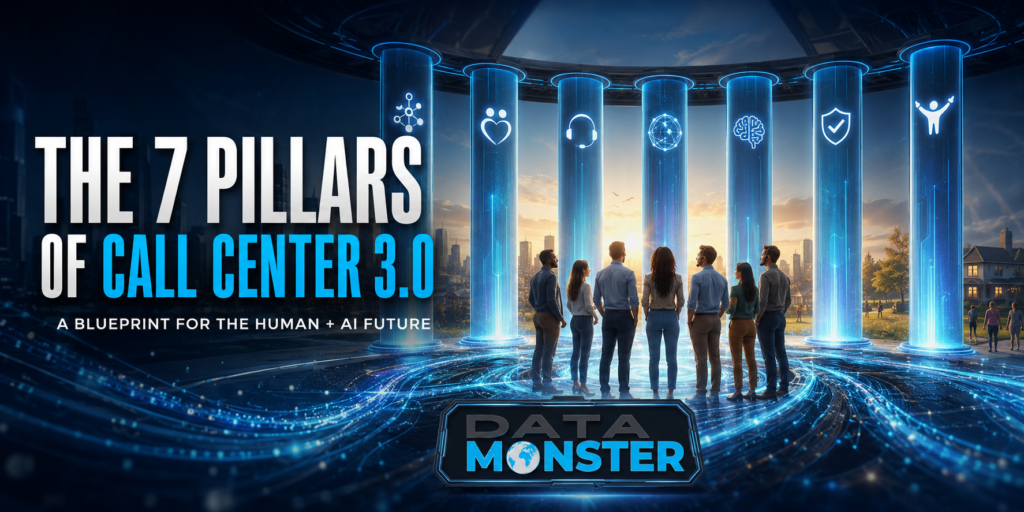
And I believe it rests on seven pillars.
Pillar 1: AI Handles Information. Humans Handle Meaning.
Artificial intelligence is extraordinarily good at information.
Machines can retrieve it.
Organize it.
Compare it.
Summarize it.
Analyze it.
Remember it.
Predict from it.
And increasingly, they can make that information available almost instantly during a customer interaction.
Humans have historically spent enormous amounts of time doing those same things.
An agent puts someone on hold.
Searches the CRM.
Looks through notes.
Finds the product.
Checks the account.
Searches a knowledge base.
Writes down what happened.
Schedules the follow-up.
Then starts over with the next customer.
AI can increasingly handle or assist with much of that.
Good.
Let it.
Because information isn’t necessarily the same thing as meaning.
A machine may know that a customer mentioned price four times.
A human salesperson may realize:
This person isn’t worried about the price. They’re afraid they’ll regret the purchase.
A machine can retrieve the customer’s history.
A human can understand why that history matters.
A machine can suggest an answer.
A human can determine whether this is the right moment to give it.
A machine can recognize words.
A great salesperson hears what’s happening between the words.
That’s the division of labor I see emerging.
The machine knows. The human understands.
Pillar 2: Humans Become Premium.
This sounds counterintuitive.
If artificial intelligence becomes more capable, shouldn’t humans become less valuable?
Not necessarily.
If AI successfully handles routine interactions, then increasingly the interactions reaching a human will be the ones that need a human.
Think about what that means.
The customer isn’t being transferred to a person because we need somebody who can type.
They’re not being transferred because we need someone who can retrieve an account number.
AI can do those things.
They’re reaching a human because something about the interaction requires judgment, empathy, persuasion, creativity, accountability or genuine communication.
That changes the value of the human being.
Personality becomes valuable.
Listening becomes valuable.
Life experience becomes valuable.
Storytelling becomes valuable.
Humor becomes valuable.
Empathy becomes valuable.
Trust becomes valuable.
The ability to calm someone down becomes valuable.
The ability to hear hesitation becomes valuable.
The ability to make a stranger feel comfortable becomes valuable.
For years, businesses called many of these qualities soft skills.
In Call Center 3.0, they may become some of the hardest skills to replace.
The more artificial customer communication becomes, the more valuable authentic humanity may become.
Pillar 3: Every Great Agent Becomes Augmented.
The call-center agent of the future shouldn’t be sitting alone with a headset, a CRM and fifteen browser tabs.
The human should be surrounded by intelligence.
This is where the Apex-Agent enters Call Center 3.0.
An Apex-Agent is what I call the next generation of AI-enhanced human sales professional.
The human remains the salesperson.
AI becomes the amplification layer.
Before the call, AI can help assemble relevant information about the customer and interaction.
During the call, AI can retrieve answers, surface relevant history, identify information that deserves attention, provide compliance reminders and supply real-time assistance.
I call that real-time intelligence The Whisper.
After the call, AI can assist with summaries, documentation, follow-up, CRM work and analysis.
Think about what that does to a talented salesperson.
Take the best closer you knew twenty years ago.
Give that person instant information.
Near-perfect access to relevant history.
Automated research.
Real-time knowledge.
Automated documentation.
And an intelligent whisper in their ear while they’re selling.
You haven’t eliminated the salesperson.
You’ve given the salesperson superpowers.
That is the Apex-Agent.
And I believe Apex-Agents will become one of the defining characteristics of Call Center 3.0.
Pillar 4: The Call Center Becomes Distributed.
The first great disruption didn’t begin with AI.
It began with remote work.
When COVID hit in 2020, the call-center industry faced a question it couldn’t avoid:
If the agent can work from home, what happens to the building?
What happens to the 750-seat center?
What happens to the 100-seat center?
What happens to the ten-person room?
The economics changed.
Some centers adapted.
Some didn’t.
Some closed.
But the genie wasn’t going back into the bottle.
Remote work proved that the call center doesn’t necessarily have to be a physical place.
Call Center 3.0 takes that idea much further.
The best person for a particular customer interaction might be in Florida.
Or the Philippines.
Or India.
Or Colombia.
Or a small American town hundreds of miles from company headquarters.
What increasingly matters is:
Talent.
Connectivity.
Availability.
Specialization.
Language.
Knowledge.
Personality.
Performance.
The call center stops being defined by rows of desks.
It becomes an intelligent network of people and technology.
The building becomes less important.
The network becomes the call center.
Pillar 5: Humans and AI Continuously Teach Each Other.
This may eventually become one of the most important parts of Call Center 3.0.
Call centers generate enormous amounts of human communication.
Questions.
Objections.
Complaints.
Buying signals.
Hesitation.
Confusion.
Anger.
Excitement.
Negotiation.
Trust.
Successful sales.
Lost sales.
Saved customers.
Lost customers.
For most of call-center history, managers could examine only a tiny percentage of those conversations.
AI changes that.
Machines can potentially analyze interactions at a scale no human quality-assurance team ever could.
What did our best salesperson do differently?
Where did customers begin losing confidence?
Which explanations consistently produced understanding?
Which questions opened conversations?
What behaviors correlate with retention?
When did a salesperson stop talking and start listening?
Why did one agent save a customer another agent might have lost?
Now something extraordinary becomes possible.
Our best humans teach the machine.
The machine recognizes patterns across enormous numbers of interactions.
That accumulated intelligence helps the next human.
That human creates another interaction.
The system learns again.
Human experience → AI learning → human assistance → better interaction → more learning.
Humans teach AI how humans communicate.
AI helps humans understand communication at a scale we’ve never possessed before.
The relationship becomes circular.
And both improve.
Pillar 6: Humanity Needs Guardrails.
There is another side to all this power.
The better AI becomes at understanding human beings, the more careful we need to become about what we do with that understanding.
Imagine technology capable of detecting that someone is afraid.
Financially vulnerable.
Confused.
Emotionally distressed.
Desperate.
Lonely.
Or unusually susceptible to a particular kind of persuasion.
There is an enormous difference between understanding someone so you can communicate with them effectively and understanding someone so you can exploit them.
Call Center 3.0 needs that line.
And it needs it clearly.
I’ve watched the call-center industry navigate decades of changing compliance requirements, including TCPA restrictions, consumer-protection rules, consent issues, privacy concerns and other regulations.
AI doesn’t eliminate the need for compliance.
It expands the conversation.
The goal cannot be to build the greatest technologically enhanced manipulation system the world has ever seen.
The goal should be better communication.
Better information.
Better service.
Better sales conversations.
Better outcomes.
Technology without judgment is dangerous.
Power without responsibility is worse.
The human being shouldn’t simply remain in the loop because AI sometimes needs assistance.
The human should also remain in the loop because somebody needs to be accountable for how that intelligence is used.
Pillar 7: Technology Should Give Humans More Freedom, Not Less.
This may be the most personal pillar of Call Center 3.0.
What is the point of all this technology if human beings end up with less control over their lives?
For generations, employment has often required people to arrange their lives around the workplace.
Clock in.
Clock out.
Commute.
Request time off.
Miss dinner.
Arrange childcare around a schedule.
Spend hours traveling to and from a building simply because that’s where the equipment happened to be.
Remote work already challenged that model.
AI could challenge it further.
If AI absorbs significant portions of routine workload…
If intelligent systems can predict demand…
If distributed platforms can connect qualified people with customer interactions…
If automation reduces the administrative work surrounding every conversation…
Then perhaps we don’t need every great salesperson sitting at a desk for eight consecutive hours waiting for the telephone to ring.
Maybe the future becomes more flexible.
An exceptional salesperson may choose the hours when they’re at their best.
A mother or father may work around their children’s schedule.
Someone caring for a family member may still have access to meaningful work.
An experienced salesperson who doesn’t want a traditional 40-hour week may contribute during peak demand.
Someone halfway around the world may cover hours that would otherwise require an American worker to take an overnight shift.
And agents may spend less of their day performing administrative work that machines can accomplish in seconds.
That is more than remote work.
That is workforce autonomy.
AI Shouldn’t Just Save Companies Time
This distinction matters to me.
Almost every conversation about AI efficiency asks:
How much money can the company save?
How many hours can we eliminate?
How many employees can we reduce?
How much more productivity can we squeeze out of the workforce?
Those are legitimate business questions.
But I think Call Center 3.0 should ask another one:
How much time can we give back to people?
If AI saves an agent two hours of repetitive administrative work, does every second of that automatically have to become another two hours of calls?
Or can some of the productivity improvement eventually create a better working life?
Technology should create prosperity in both directions.
The business should benefit.
The customer should benefit.
And the worker should benefit.
That is the Call Center 3.0 version of efficiency I want to see.
Freedom Could Also Produce Better Agents
There is a business argument for this too.
A miserable salesperson isn’t necessarily a productive salesperson.
A burned-out customer-service representative isn’t likely to deliver extraordinary empathy.
Someone staring at the clock waiting to leave isn’t giving you their best human communication.
If we’re saying that personality, empathy, judgment and human connection become premium qualities in Call Center 3.0, then perhaps we should create working environments where those qualities can actually thrive.
People need lives.
Families.
Rest.
Experiences.
Relationships.
Interests.
All the things that make someone an interesting, relatable human being in the first place.
Life experience makes better storytellers.
Human experience creates empathy.
And ironically, giving people more freedom to actually live may make them better at the very human qualities we’re asking them to bring to work.
This Is Bigger Than Artificial Intelligence
That’s why I believe the Call Center 3.0 revolution may be bigger than we think.
This isn’t simply a technology upgrade.
It affects:
what machines do,
what humans do,
who we hire,
where they work,
how they work,
how they’re measured,
how technology learns,
how humans improve,
and potentially how work fits into life itself.
That is an operating-model transformation.
And it won’t happen overnight.
Some organizations will embrace pieces of it.
Some will resist it.
Some will automate too aggressively.
Some won’t automate quickly enough.
We’ll make mistakes.
AI will make mistakes.
Regulators will respond.
Customers will tell us what they accept and what they reject.
And the model will continue evolving.
That’s how revolutions work.
The Seven Pillars of Call Center 3.0
So when someone asks me what I mean by Call Center 3.0, this is my answer:
1. AI handles information. Humans handle meaning.
Let machines process. Let humans understand.
2. Humans become premium.
When we choose human interaction, make humanity the reason.
3. Every great agent becomes augmented.
Create Apex-Agents. Give exceptional humans exceptional intelligence.
4. The call center becomes distributed.
Stop defining the industry by buildings. Build networks of talent.
5. Humans and AI continuously teach one another.
Turn millions of conversations into intelligence that makes both sides better.
6. Humanity needs guardrails.
Use understanding to serve people, never to exploit vulnerability.
7. Technology should give humans more freedom, not less.
Let productivity create autonomy, flexibility and a better quality of life—not simply another way to squeeze more out of people.
Those are the seven pillars.
Not seven predictions carved into stone.
A philosophy.
A direction.
A blueprint for an industry entering unfamiliar territory.
Build Something Better
We’ve been given extraordinary technology.
We can use it simply to reduce headcount.
We can use it simply to lower costs.
We can use it to make machines imitate people.
Or we can think bigger.
We can let machines handle more of what machines do extraordinarily well.
We can let humans concentrate on what humans do extraordinarily well.
We can give talented people capabilities that salespeople and customer-service professionals of previous generations could only dream about.
We can build distributed workforces based increasingly on talent rather than geography.
We can study communication and help people become better communicators.
We can create safeguards that protect customers as our ability to understand them becomes more sophisticated.
And maybe—if we do this correctly—we can use all that productivity to give people something technology has been promising humanity for generations:
More freedom.
More time with family.
More control over when and where they work.
More opportunity to earn based on what they contribute rather than where they happen to sit.
That’s the Call Center 3.0 I want to see.
Not humans serving machines.
Not machines replacing humans.
Machines empowering humans.
Seven pillars.
One new operating philosophy.
And an opportunity to build something far better than what came before.
Welcome to Call Center 3.0.
— William Shivers
Call Center Industry Veteran | 30+ Years of Experience
CallCentersForHire.com